Are 88WIN and Win88 the same brand? A name-verification guide
Are 88WIN and Win88 the same brand? A four-step check on first-party sources, complete domains, page purpose, and dates — so similar names don't become assumed identity.
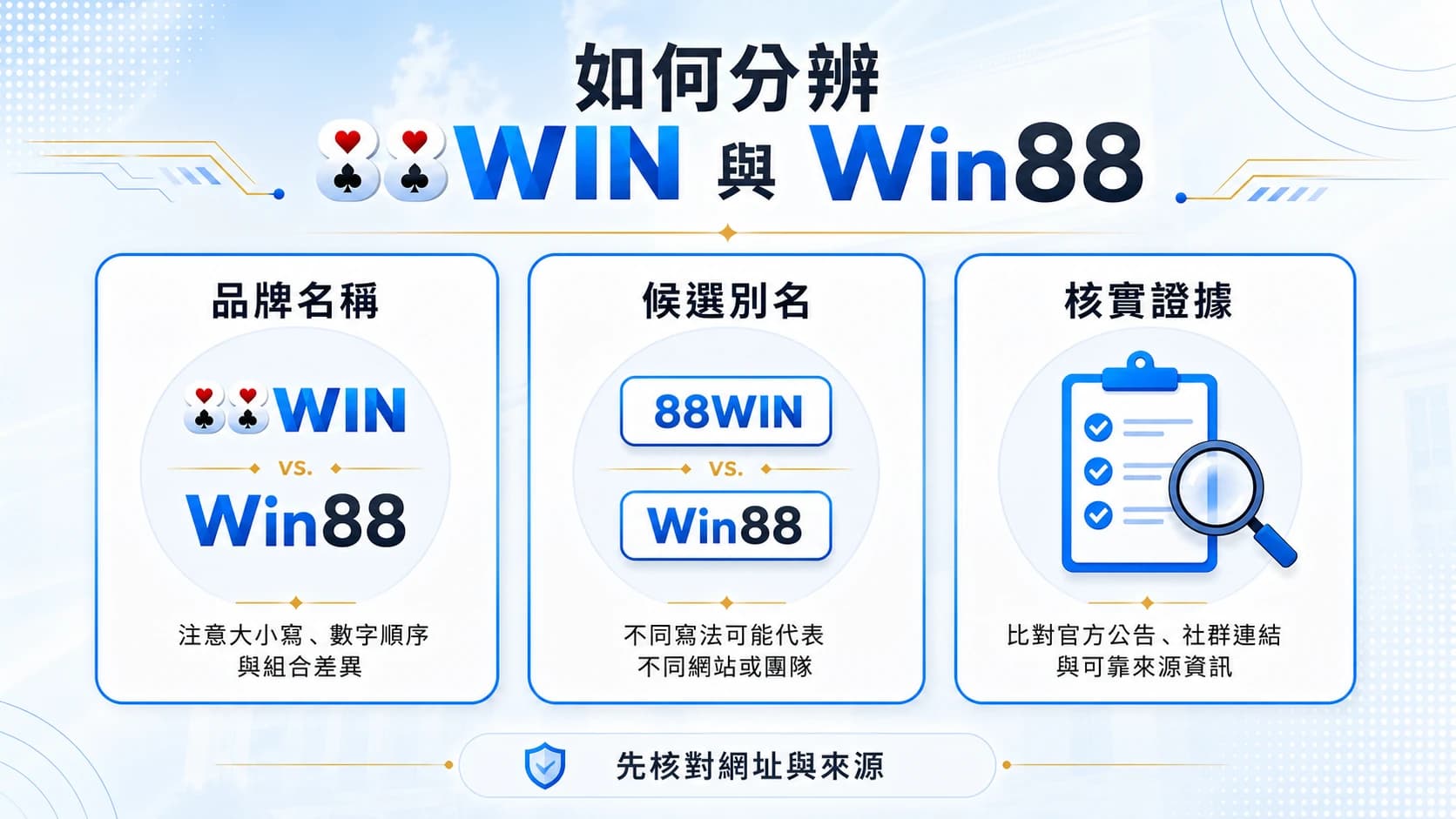
"88WIN" and "Win88" swap two elements, which makes them look like two spellings of one name. Surface similarity is not evidence of a brand relationship — licensing, agency, and shared ownership all require a traceable first-party statement, not an ordering of letters.
Can they be treated as one brand?
Until a traceable first-party statement turns up, the safer position is to mark Win88 as an unverified candidate spelling rather than confirming it as an alias. That isn't a denial of any relationship; it's an acknowledgement that the evidence to support one isn't in hand.
| Name seen | Current role | What you can do with it | What it can't establish |
|---|---|---|---|
| 88WIN | Primary query term | Organise the brand, domains, and entry points | The name alone can't prove which URLs belong to whom |
| Win88 | Unverified candidate spelling | Look for an explicit, traceable first-party statement | Letter similarity can't establish a brand relationship |
| Lookalike domains | Strings requiring character-by-character comparison | Compare every character of the domain | Can't be inferred to be sub-sites or mirrors |
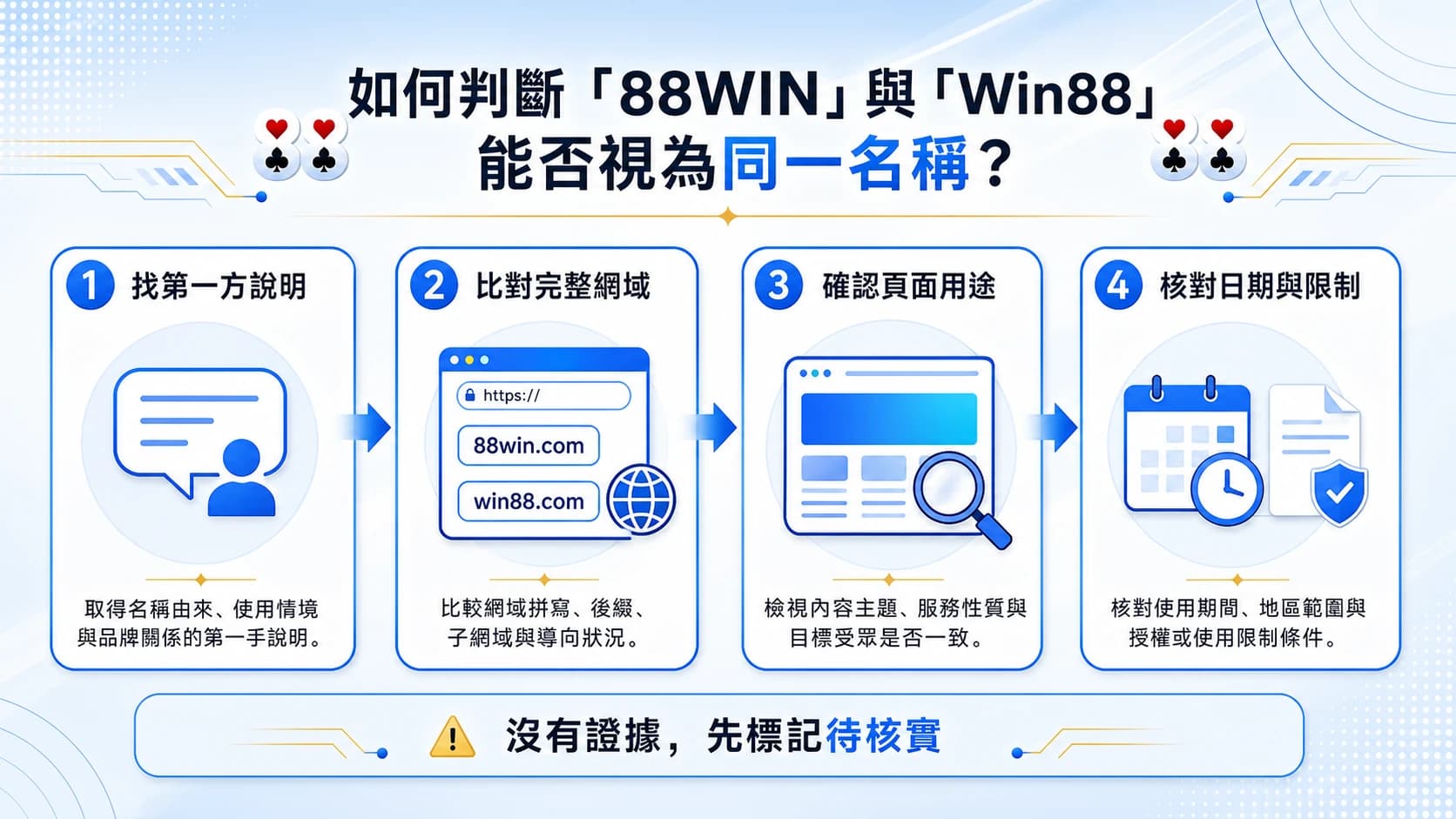
Four steps for judging the relationship
- Find the first-party source — Brand relationships should be stated by the parties involved; third-party articles supply leads only.
- Compare complete domains — Compare the full domains character by character, not the names printed on the pages.
- Confirm page purpose — An information page and a service entry point play different roles and shouldn't be conflated.
- Check the date — Brand relationships change over time; an undated statement is background only.
The claims that most often mislead
Reversed letters therefore the same brand
Similar names are extremely common within an industry, and the similarity is frequently the thing being exploited. Treat a textual resemblance as worth checking, never as the conclusion.
Logo, colours, or layout as proof of authorisation
Visual elements are cheap to copy. A similar layout shows at most that someone looked at someone else's design; it establishes neither licensing nor shared operation.
The word "official" standing in for evidence
Any page can put "official" in its title. The word is a claim, not a proof; what still needs judging is whether a traceable source sits behind the claim.
FAQ: 88WIN and Win88 name checks
Is Win88 an alias of 88WIN?
Until an explicit first-party statement is found, holding the answer at "unverified" is safest. The answer may change with new evidence — but it should be evidence that moves it.
The top search result says "Win88 official" — is that enough?
Ranking reflects a search engine's relevance judgement, not a check on brand authorisation. The first result and the tenth carry no inherent difference in evidential weight.
What if both names lead to the same login page?
That's an observation worth recording, and still not a conclusion. Different sources can point at one page for many reasons. Note the complete URL and the time, then go looking for a first-party statement.
Writing a provisional conclusion
Write conclusions with their state attached: "as of this date, no traceable first-party statement confirming a relationship has been found." That phrasing preserves the time and evidence conditions, so new information updates it rather than overturning it.
In closing: names are leads, not proof
A name is where verification starts, not where it ends. Treat similar names as a signal to check, then narrow with first-party sources, complete domains, page purpose, and dates — that's usually enough to avoid most misjudgements.