
How to verify 88WIN information: main site, third parties, and stale data
How do you tell the main site from third-party write-ups, search snippets, and out-of-date pages? A checklist built on source, primary documents, dates, and claim boundaries.
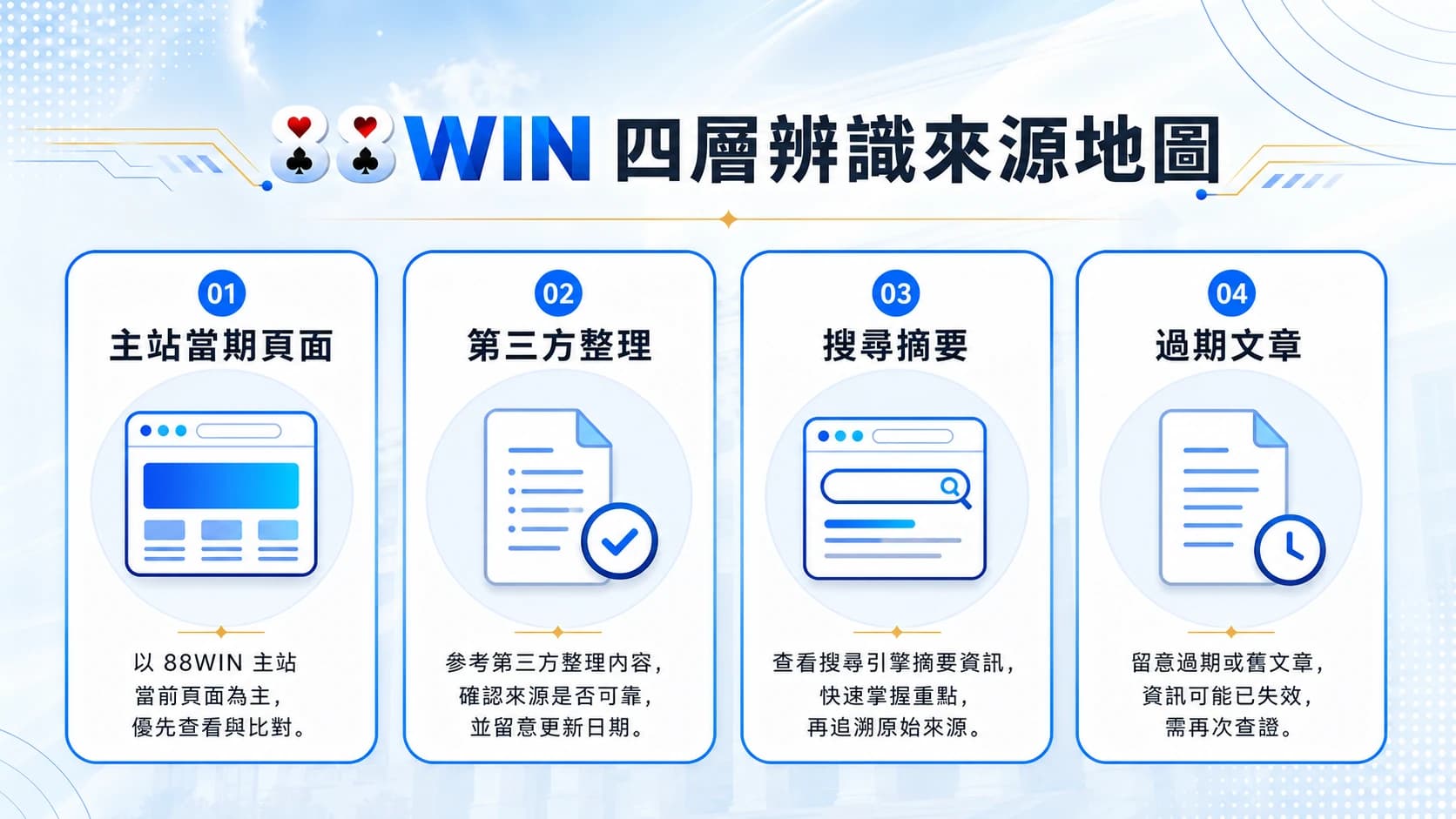
Search for 88WIN and one question tends to return several answers: main-site pages, third-party round-ups, search-engine snippets, and posts written years ago and never revisited. All of it looks like information, but the reliability differs enormously. Working out what role a piece of content plays, before deciding whether to act on it, is the fastest route through.
Main site, third-party content, and stale data

Once you separate sources by layer, most apparent contradictions turn out not to be disagreements at all — they're different layers being compared as if they were equivalent.
| Source type | What it can answer | What it can't replace |
|---|---|---|
| Main site and policy pages | Current scope of service, terms wording, support channels | The outcome of your individual case |
| Traceable first-party notices | Dated changes, campaign start and end dates | Anything adjusted after the notice date |
| Third-party write-ups | Background, terminology, comparative framing | Current terms, amounts, and timings |
| Search snippets | Quickly locating possibly relevant pages | The page's actual content — snippets can come from old versions |
Establish which layer a statement belongs to before deciding how strong a conclusion it can support.
Five fields for judging whether an article is usable
- Author and desk — Is a writer or editorial desk named? Fully anonymous content drops a level.
- Primary documents — Do the key claims link to traceable sources? Screenshots and paraphrase count as unverified.
- Dates — Are publication and update dates stated? An undated page is background only.
- Claim boundaries — Does the author separate verified fact from their own inference? If not, you have to do it.
- Reproducibility — Could you re-run the same check from the clues given? If not, it isn't verifiable.
Write your findings down so you can revisit them
Re-checking the same question every few weeks tends to produce inconsistent answers. Leave a minimal record at the moment you check: the date, the full URL you saw, the page title, the exact wording of the key passage, and the status you assigned — confirmed, unverified, or expired.
- Date and time of the check
- The complete domain as shown in the address bar
- Page title and update date
- A verbatim excerpt of the key passage
- Your status call, plus one sentence of reasoning
Three common traps
A recent update date means the content is correct
An update date tells you the page was touched, not that the body text was. Plenty of pages get a layout or tag change while the copy stays as it was. Dates are a sorting cue, not proof of accuracy.
Lots of images and comments mean the data is trustworthy
Images and comments reflect production budget and traffic, not verification effort. Credibility comes from traceable sources, not from how finished a page looks.
A confidently written third-party article can replace support
Confident tone and factual accuracy are unrelated. For anything touching accounts, transactions, or individual cases, a third-party article offers background at best — the actual outcome still has to come through a verifiable support channel.
FAQ: reading 88WIN information sources
How do I tell whether a page is main-site information?
Start with the complete domain, then check whether the page is reachable from the main site's navigation or its formal policy pages. The words "official site" printed on a page settle nothing on their own.
Are old articles still worth reading?
Yes, as background. Older pieces are good for concepts and context, and poor for today's amounts, processes, and timings.
Can I trust an article that quotes a search snippet?
A snippet is an automatically extracted fragment that may come from an old version of a page or from a passage that wasn't the point. Quoting a snippet is not quoting a source — go back to the original page.
Keep a small source ledger
If you check this kind of thing regularly, a very small ledger is enough: one row per source, recording its role (main site / first-party notice / third party / snippet), the date you last checked it, and how much you trust it. Next time the same URL appears, consult the ledger before re-checking from scratch.
In closing: establish the role, then decide
Verification needs a fixed order more than it needs tools. Establish the source layer, check dates and primary documents, and only then judge how strong a conclusion the passage supports. Make that order habitual and most seemingly contradictory search results become straightforward.