What is 88WIN? Identifying the brand, the main site, and information pages
Want to know what 88WIN is? A four-quadrant check on source, URL, main site, and information pages, so unverified claims don't get read as official statements.
When people search for 88WIN, what they usually want isn't the brand name at all. It's: which URL is the main entry point? Which page is only a write-up? And when a similar name appears, can it be treated as the same brand? Left tangled together, those questions are exactly what lookalike domains, expired posts, and third-party claims exploit.
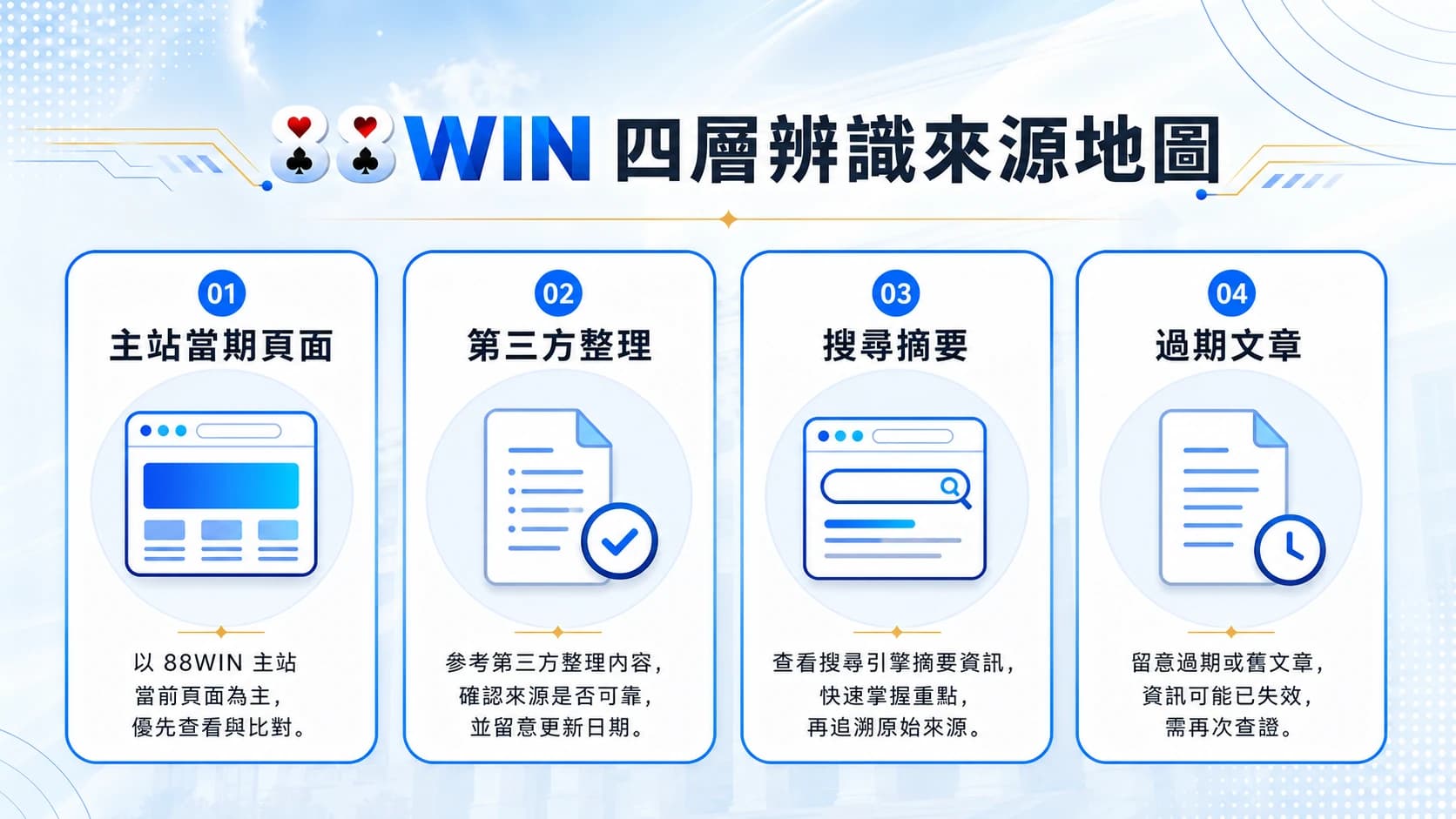
Check four fields: source, domain, page purpose, and update date. A URL that looks right, or a page captioned "official site", proves nothing on its own.
Separate the brand, the main site, and information pages
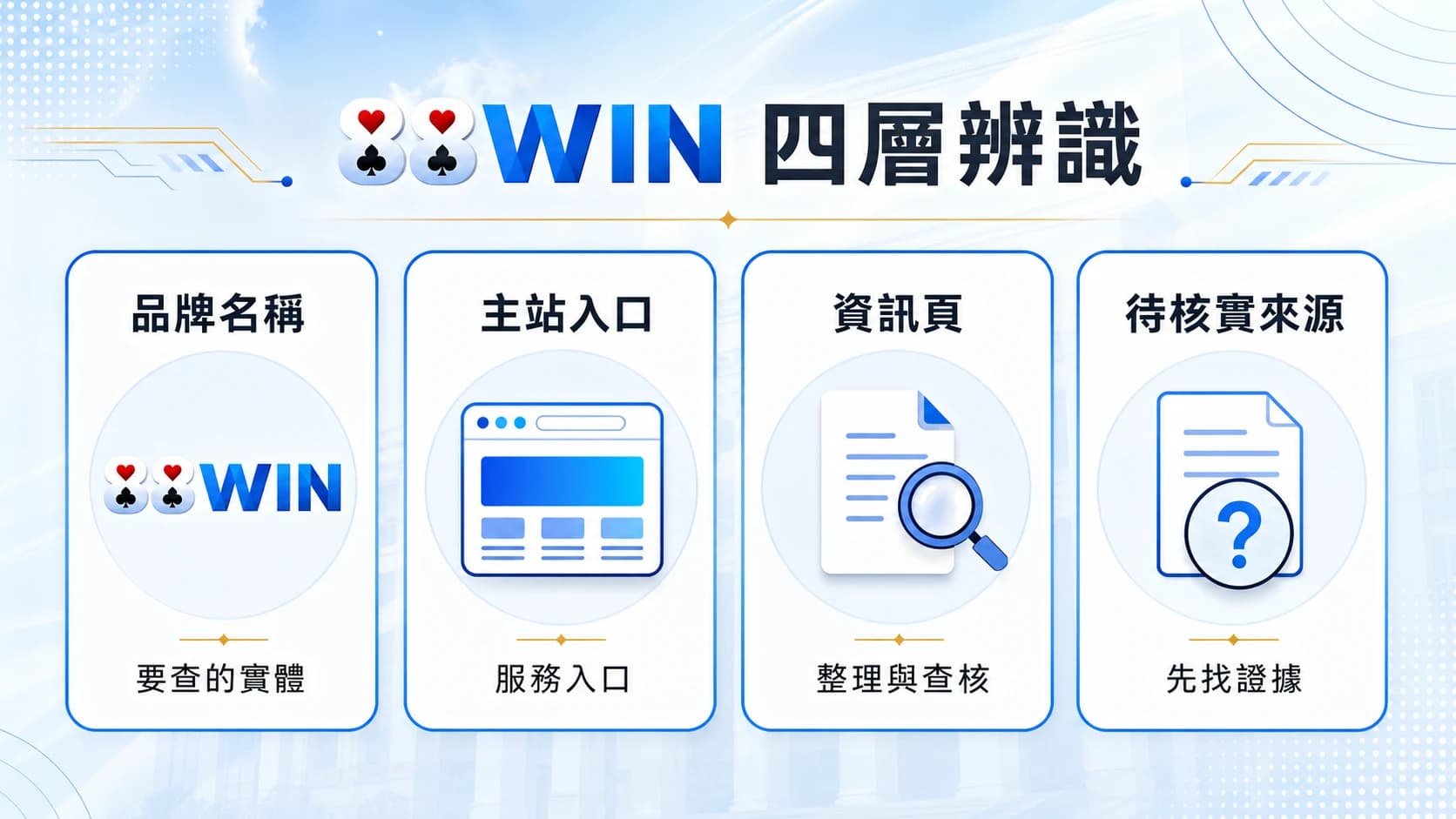
The first time you look into a brand, put the names into separate columns rather than collapsing everything into one "official" conclusion. The payoff is that a new URL or article later can be judged with the same method.
| Role | What it's responsible for | What it can't establish |
|---|---|---|
| Brand name | The starting point and organising axis for a search | The name alone can't establish which URLs belong to it |
| Main service entry | Actual login, registration, and account operations | A URL can't imply financial safety or a service guarantee |
| Information and troubleshooting pages | Verification frameworks, check order, risk notes | Not a substitute for support; never asks for passwords or codes |
| Third-party articles | Background and comparative framing | Can't replace current terms or first-party notices |
The point of the table is to hold "brand name", "site role", and "evidence" apart. Several similar names appearing in one set of search results is entirely normal, and their appearing together implies no licensing, agency, or shared operator.
The fact / source / inference / unknown grid
What most often trips readers up online is an author's speculation written in the grammar of established fact. Sort each sentence into one of four boxes, especially anything touching logins, payments, bonuses, support, or safety.
| Field | What it asks | Example when checking |
|---|---|---|
| Fact | What can actually be seen on the page? | The complete domain in the address bar, page title, update date, policy links |
| Source | Who is making this statement? | A main-site page, a traceable first-party notice, or just a third-party article |
| Inference | What has the author derived? | Guessing two URLs are one service because the names look alike |
| Unknown | Which document is still missing? | Licensing, operator identity, and current terms with nothing verifiable found |
If an article states "this is the only entry point", tag it as a third-party claim first, then confirm against the main site and traceable first-party pages. Ranking, visual design, a padlock icon, and comment counts are not substitutes for source evidence. HTTPS is transport encryption — not brand authorisation, and not a guarantee about payment outcomes.
Five steps for checking a URL and its purpose
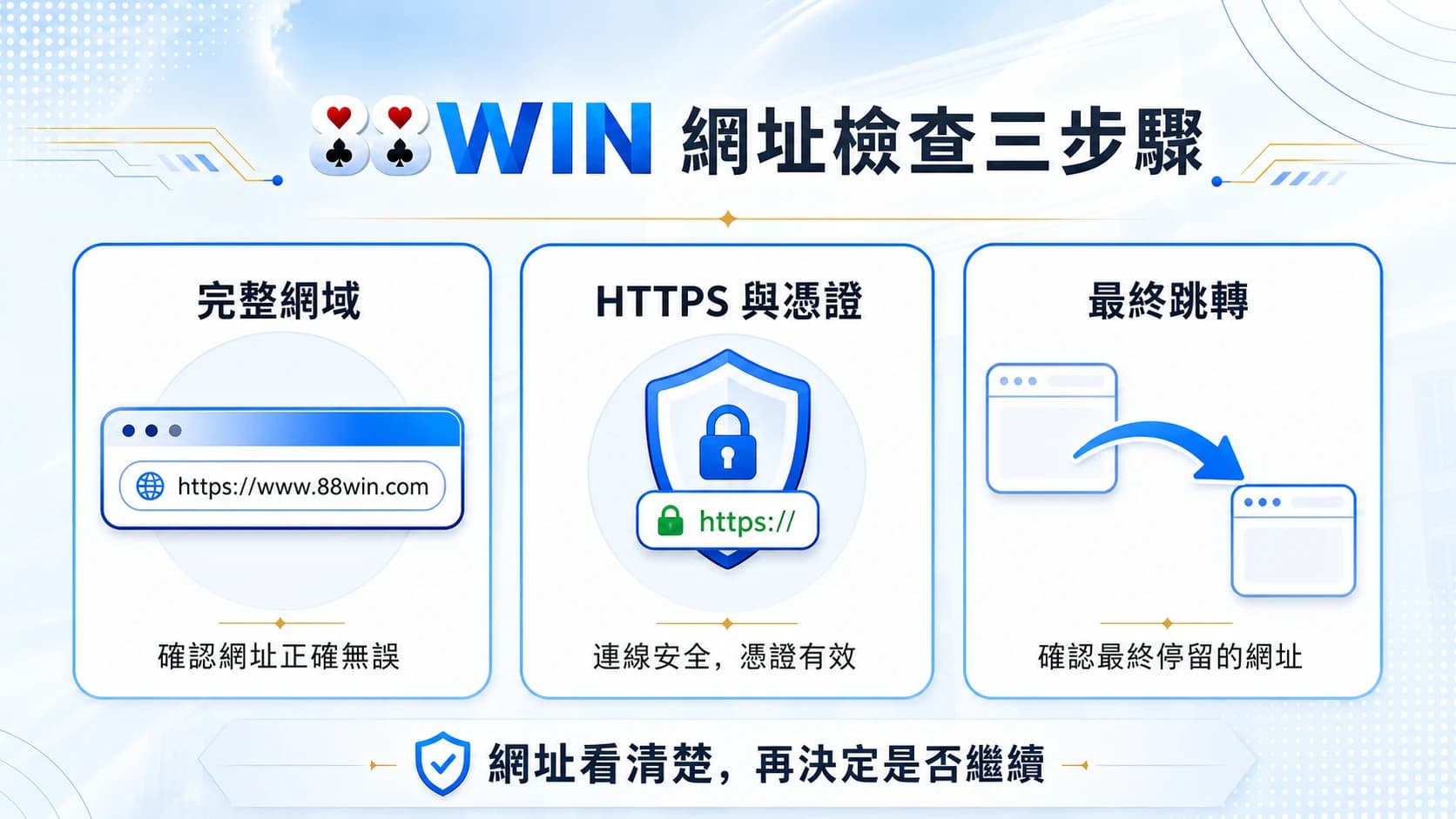
- Read the complete domain — Read the address bar end to end, watching spelling, digits, hyphens, and the suffix.
- Confirm what you came to do — Reading, logging in, registering, depositing, and contacting support are different page purposes.
- Find the first-party source — Prefer content reachable from the main site's navigation or formal policy pages.
- Check dates and terms — Bonuses, payment methods, verification flows, and service hours all change.
- Stop when sensitive data is requested — Passwords, SMS codes, and bank details don't get handed over on a claim of being support.
Why search results can't just be followed
Treating the word "official" as proof
Any page can print "official" in its title and body. It's a claim, and its weight depends entirely on whether a traceable first-party source stands behind it.
Reading a lookalike domain as a sub-site or mirror
Sub-sites, mirrors, and lookalike domains are technically unrelated things. A matching prefix doesn't imply a shared operator — compare the whole domain.
Using expired bonuses or old support details for today's problem
Terms, amounts, timings, and channels all change. An undated old article works as background and is a poor basis for acting on today's account or payment question.
FAQ: what people hit when searching for 88WIN
Is it safe to enter details once I see HTTPS?
No. HTTPS guarantees encryption in transit, not the identity behind the site or the quality of the service. Lookalike domains obtain certificates too.
Someone says they're support — should I give them the code?
No. The entire purpose of an SMS code is to verify that it's you. Any situation where you're asked to read one out is a reason to stop and confirm through a verifiable support channel.
In closing: check the source, then decide
Identifying a brand takes a fixed order rather than special tools: separate the roles, check source and date, and only then conclude. Made habitual, it holds up well against a messy set of search results.